
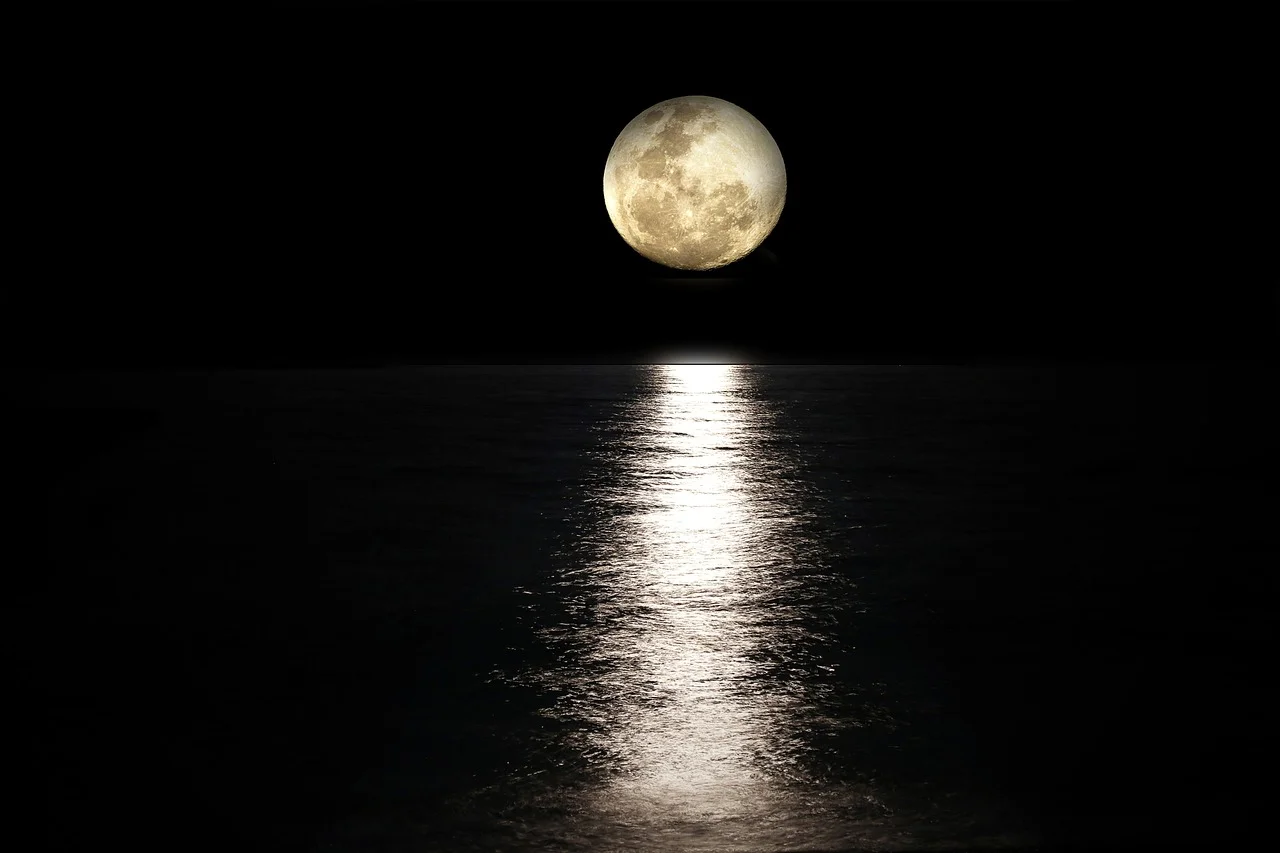
The Moon can affect the ocean because gravity does not need to touch something to pull on it. Every object with mass attracts other objects with mass. The pull gets weaker with distance, but it does not suddenly stop just because the Moon is far away.
Still, the Moon is not simply yanking the sea straight upward like a magnet lifting paper clips. The tide comes from a small difference in the Moon’s pull across Earth. The side of Earth facing the Moon feels a slightly stronger pull than Earth’s center does. The far side feels a slightly weaker pull. NOAA describes this as a differential force, and that difference stretches Earth and its oceans a little.
Water makes this stretching easy to notice. Ocean water can flow, so it can pile up into broad tidal bulges. As Earth rotates through those bulges, many coasts experience high and low tides. The real coastline pattern is messier because continents, seafloor shape, wind, pressure, and local geography all affect what happens at a particular beach.
This is also why the Moon can be far away and still matter. A tiny pull spread across an entire ocean can add up to a visible rise and fall. You would not notice the Moon pulling a cup of water on your table because the cup is small, the effect is tiny, and the cup’s walls hold the water in place. The ocean is enormous and free to move.
The Sun also creates tides, even though it is much farther away than the Moon. Its gravity is strong because the Sun is so massive, but the tide-making effect depends on how much the pull changes across Earth. NOAA explains that the Sun’s tide-making effect is smaller than the Moon’s, and the two combine during spring and neap tides.
So what else can the Moon attract besides water? In principle, everything with mass: rocks, air, people, buildings, and Earth itself. In practice, most solid things do not slosh around the way water does, so the effect is harder to see. The ground has Earth tides, too. USGS describes them as small, slow ground movements caused by the gravitational attraction of the Sun and Moon.
The atmosphere can also have tides. A NASA Goddard science note says the Moon creates tides in the atmosphere as well as in the ocean, making a small atmospheric bulge and waves that can travel upward into higher layers. The effect is subtle, but it is real enough for scientists to measure.
The short version: the Moon pulls on all of Earth, not just the sea. We notice ocean tides most because water is mobile, oceans are huge, and even a small difference in gravity across Earth can move a lot of water.
Image by photo-graphe from Pixabay
References
- What Causes Tides? | NOAA NESDIS
- Gravity, Inertia, and the Two Bulges | NOAA National Ocean Service
- Forces | NASA Science
- Newton’s Universal Law of Gravitation | OpenStax
- Volcano Watch: Earth Tides and Volcano Monitoring | U.S. Geological Survey
- Lunar Atmospheric Tides Affect Our Space Environment | NASA Goddard
Explore More
- Why are there usually two high tides in one day?
- Why does the Sun create smaller tides than the Moon?
- Why are tides huge in some bays but tiny on some coasts?
- Can the Moon really affect earthquakes or volcanoes?
- What would tides look like if Earth had no continents?