
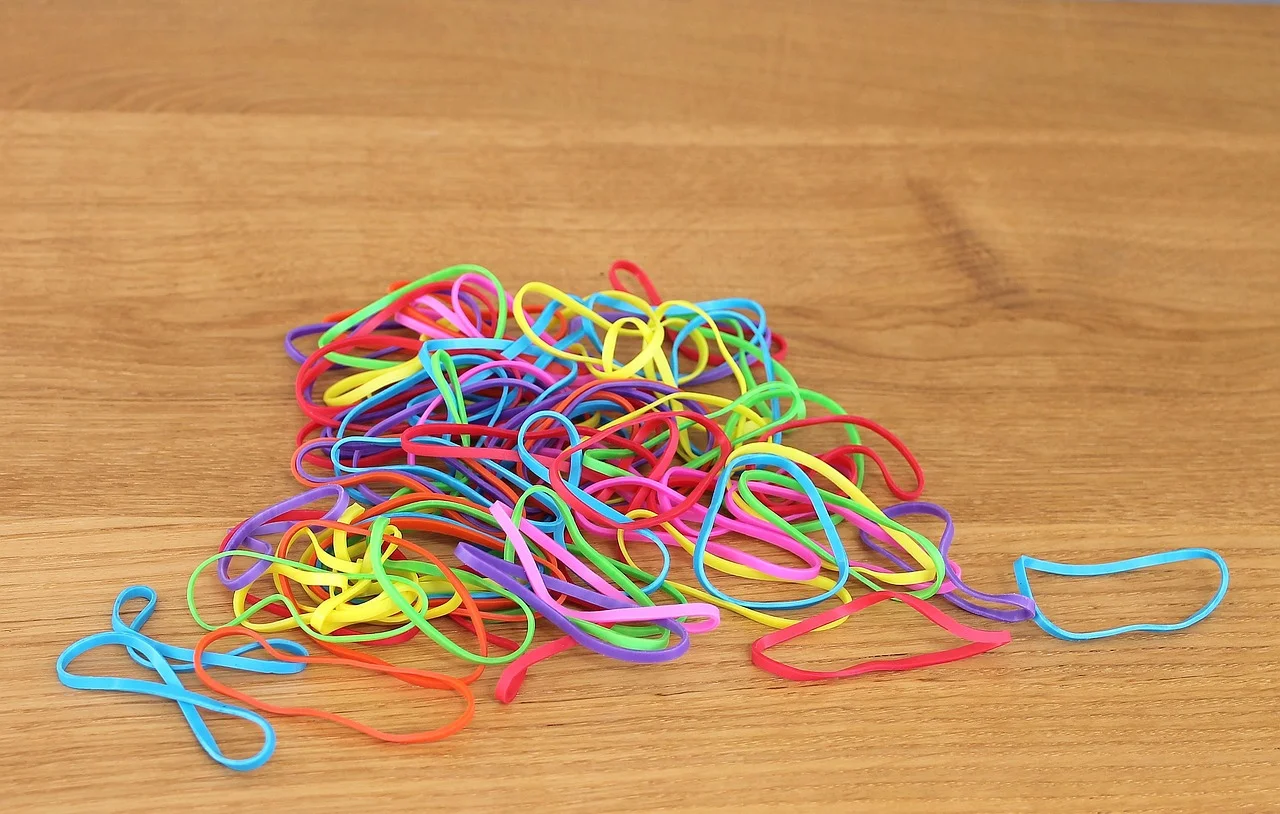
A rubber band feels simple, but inside it is a crowd of long chainlike molecules. Britannica describes elastomers as rubbery materials made of long polymers that can recover their shape after being stretched. In a relaxed rubber band, those chains are curled and tangled in a random way.
When you stretch the band, you force many of those chains to straighten and line up more than they want to. When you let go quickly, the chains can usually curl back toward their messy, relaxed arrangement. LibreTexts describes this as chains in the amorphous regions straightening under tension and returning when the tension is released.
The trouble starts when the rubber band is held stretched for a long time. Polymers are often viscoelastic, which means they behave partly like a spring and partly like a very slow-flowing material. OpenLearn explains that if a constant deformation is imposed, the stress in a polymer relaxes with time. In everyday terms: the band slowly stops pulling as hard.
There is a related effect called creep. If a polymer is held under a steady load, its strain can increase over time. Penn State’s polymer materials course says many polymers show time-dependent behavior, including creep and stress relaxation, and that a polymer may recover some shape after stress is removed but often has some permanent deformation.
That is why a rubber band left around a stack of cards may come off loose and sad-looking. Its chains did not all snap at once. Some parts shifted, relaxed, or became rearranged while the band was forced to stay stretched. The band may still be rubber, but its old “resting shape” has partly changed.
Cross-links are supposed to help prevent that. Vulcanized rubber has chemical links between polymer chains, and Britannica says those links convert rubber into a solid network that will not simply flow. LibreTexts says cross-links reduce plastic flow and give stretched rubber a reference framework to return to. But cross-links are not magic; stretch a cheap band too far, too long, or too many times, and the network can still lose performance.
Age makes the problem worse. Rubber also changes chemically as it sits around. A Springer Nature article on natural rubber ageing says environmental influences such as temperature, UV light, humidity, oil, fuel, oxygen, and ozone can affect elastomer properties, and that irreversible changes are often chemical. Ozone in particular can cause surface cracking and molecular changes in natural rubber.
So a rubber band loses elasticity for two main reasons: time under stretch lets the polymer network relax or creep, and the material can chemically age from oxygen, ozone, heat, light, and other exposures. Leaving it stretched is like asking the tiny molecular springs to hold a pose until some of them forget where home was.
References
- Elastomer | Britannica
- Chemical Interlinking: From Elastomers to Rubbery Solids | Britannica
- Polymer Structure and Physical Properties | Chemistry LibreTexts
- Viscoelasticity and Master Curves | OpenLearn
- Polymers as Viscoelastic Materials | Penn State MATSE 202
- Ozone Ageing: Experimental Methods on Pristine and Protected Natural Rubber | Springer Nature
Explore More
- Why does a rubber band get warm when you stretch it?
- Why do old rubber bands become brittle or sticky?
- What is vulcanized rubber?
- Why are some elastics better than others?
- Why do tires crack even when they are not driven much?