
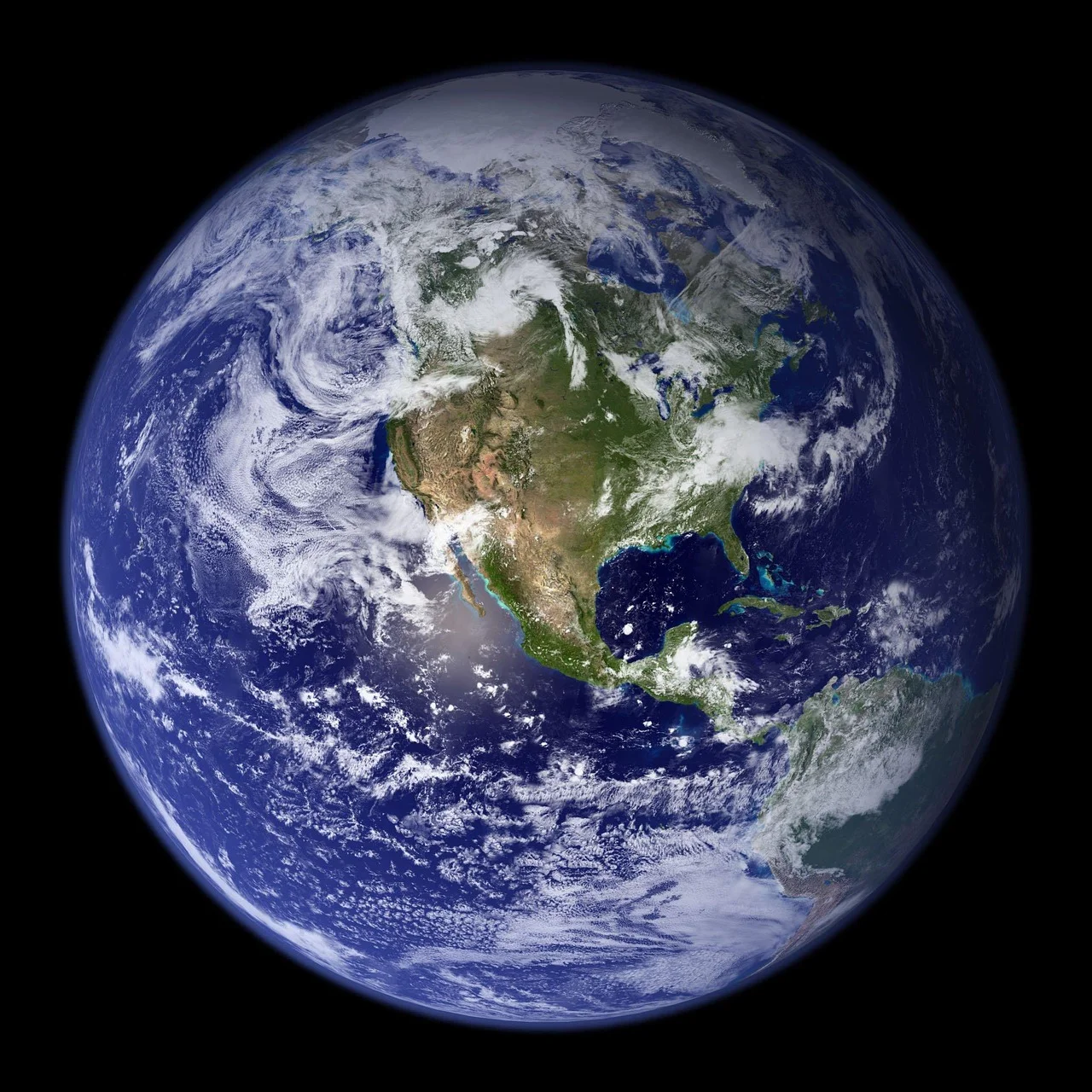
Scientists do not find Earth’s birthday by digging up one perfect “first rock.” That rock probably does not exist anymore. Earth has been melted, squeezed, eroded, buried, and recycled by plate tectonics for billions of years, so the planet has destroyed much of its own earliest evidence.
The best estimate today is that Earth is about 4.54 billion years old. That number is not a guess from one rock. It comes from comparing Earth with other old Solar System materials, especially meteorites, and using radiometric dating to measure how long certain atomic clocks have been ticking.
Radiometric dating works because some atoms are unstable. Over time, a radioactive “parent” isotope changes into a more stable “daughter” isotope at a predictable rate. If scientists know that rate and measure the parent-to-daughter ratio in a mineral, they can calculate when that mineral last crystallized or was reset by heat.
This is why carbon dating is not the tool for Earth’s age. Carbon-14 is useful for once-living material only up to tens of thousands of years old. For deep time, geologists use slower clocks, such as uranium turning into lead, potassium turning into argon, or samarium turning into neodymium.
Earth rocks still help, but mostly as clues. The oldest known rocks on Earth are over 4 billion years old, and tiny zircon crystals from Western Australia are around 4.3 to 4.4 billion years old. Those crystals prove Earth is at least that old, but they do not mark the moment the whole planet formed.
Meteorites are more useful for the starting line. Many meteorites are leftover pieces from the early Solar System, not rocks that went through Earth’s recycling machine. USGS says more than 70 meteorites dated by radiometric methods show ages between about 4.53 and 4.58 billion years, which points to the time when solid bodies in the Solar System were forming.
One especially important method compares lead isotopes. Uranium-235 and uranium-238 decay into different lead isotopes, and the lead ratios in old Earth materials can be compared with lead in iron meteorites such as the Canyon Diablo meteorite. That calculation gives an age of about 4.54 billion years, with an uncertainty of less than 1 percent.
So “Earth’s age” really means the time when Earth and the other solid bodies of the inner Solar System were coming together from the same cloud of gas and dust. It is not a birthday in the human sense. Planet formation was a messy process of dust, rocks, collisions, melting, and rebuilding.
The short version is this: scientists date old minerals, Moon rocks, and especially meteorites, then use physics to connect those clocks back to the formation of Earth. Earth hid many of its first pages, but meteorites kept copies of the opening chapter.
Image by WikiImages from Pixabay
References
- Age of the Earth – USGS Publications Warehouse
- Radiometric Age Dating – National Park Service
- Radiometric Dating: Clair Patterson – Understanding Evolution
- Facts About Earth – NASA Science
- Formation of Our Solar System – American Museum of Natural History
- How old is the Earth? – The Planetary Society
- Research Yields Greater Precision in Determining Age of Meteorites – Planetary Science Institute
Explore More
- Why are meteorites better than Earth rocks for dating the early Solar System?
- What is the difference between carbon dating and uranium-lead dating?
- How old are the oldest minerals ever found on Earth?
- Why does plate tectonics erase so much of Earth’s early history?
- How did Clair Patterson use meteorites to estimate Earth’s age?