
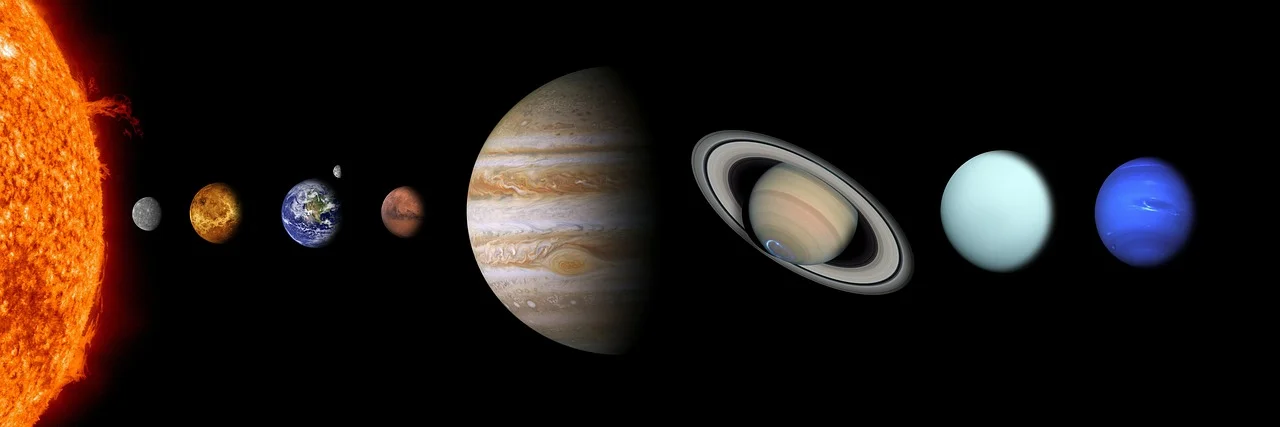
Scientists do not predict the Solar System’s future with a single countdown clock. They ask a few related questions: how long the Sun will stay stable, what happens when it becomes a red giant, whether Earth survives, and whether the remaining planets keep orbiting after the Sun becomes a white dwarf.
The first clock is the Sun itself. NASA describes the Sun as a 4.5-billion-year-old yellow dwarf star, powered by nuclear fusion in its core. Because scientists know the Sun’s mass, brightness, composition, and fusion physics, they can compare it with stellar evolution models and with other stars at different life stages.
Those models say the Sun is a little less than halfway through its lifetime. NASA’s Sun facts page says the Sun will last about another 5 billion years before it becomes a white dwarf. ESA describes a similar path by saying the Sun becomes a red giant around 10 to 11 billion years of age, which is roughly 5 to 6 billion years from now.
The red giant stage is the dramatic part. As the Sun runs low on hydrogen in its core, the core contracts and heats, while the outer layers puff outward. National Geographic explains that the Sun will expand over the next five billion years from a yellow dwarf toward a red giant, swallowing Mercury and Venus. NASA’s exoplanet guide says Mercury and Venus are expected to be swallowed, while Earth’s exact fate is less clear.
Even if Earth somehow avoids being swallowed, it would not stay comfortable. A swollen, aging Sun would pour far more energy onto the inner Solar System. NASA’s guide is blunt: Earth will not be habitable by then, and surviving planets would face intense radiation from the expanding Sun.
After that, the Sun does not explode like a supernova. It is not massive enough. NASA’s white dwarf explainer says a Sun-like star sheds its outer layers, leaves a planetary nebula, and ends as a white dwarf. During that late phase, the Sun may lose about half its mass, so the orbits of surviving outer planets can expand rather than instantly vanish.
That is why the “end of the Solar System” depends on what you mean. If you mean the Solar System as we know it, with a stable Sun and familiar inner planets, the answer is about 5 billion years. If you mean any leftover planets, asteroids, and icy bodies still orbiting the Sun’s white-dwarf remnant, the system could continue in a colder, altered form for much longer.
Scientists also test the planets’ orbits with computer simulations. The Solar System is chaotic over very long times, meaning tiny differences today can grow into big differences after tens or hundreds of millions of years. The Institute for Advanced Study explains that researchers launch many slightly different simulated Solar Systems and study the statistics, not one guaranteed future.
The comforting part is that the current layout is probably stable until the Sun’s late-life changes. One famous set of 2,501 simulations found that about 1 percent made Mercury’s orbit stretched enough that it could collide with Venus or the Sun. One of those high-eccentricity cases went further, destabilizing the inner rocky planets about 3.34 billion years from now, with possible collisions involving Mercury, Mars, Venus, and Earth. In other words, the planetary dance is not perfectly predictable, but the main danger still comes from the Sun’s own aging.
References
- Our Sun: Facts – NASA Science
- Chapter 6: Aging Into Gianthood – NASA Science
- The Sun’s future – European Space Agency
- White Dwarfs – NASA Imagine the Universe
- Sun – National Geographic Education
- What Happens to the Planets When the Sun Becomes a Red Giant and White Dwarf? – National Radio Astronomy Observatory
- Is the Solar System Stable? – Institute for Advanced Study
- Existence of collisional trajectories of Mercury, Mars and Venus with the Earth – PubMed
Explore More
- Why will the Sun become a red giant instead of exploding as a supernova?
- Could Earth survive the Sun’s red giant phase?
- What happens to Jupiter and Saturn when the Sun becomes a white dwarf?
- Why are planetary orbits predictable for years but uncertain over billions of years?
- How do astronomers test the future of the Solar System on computers?