
The short answer is: sunlight is white to human eyes when you see the full mix without Earth’s atmosphere changing it much. That may sound odd if you grew up drawing the Sun as a yellow circle, but white light is exactly what you get when many visible colors arrive together.
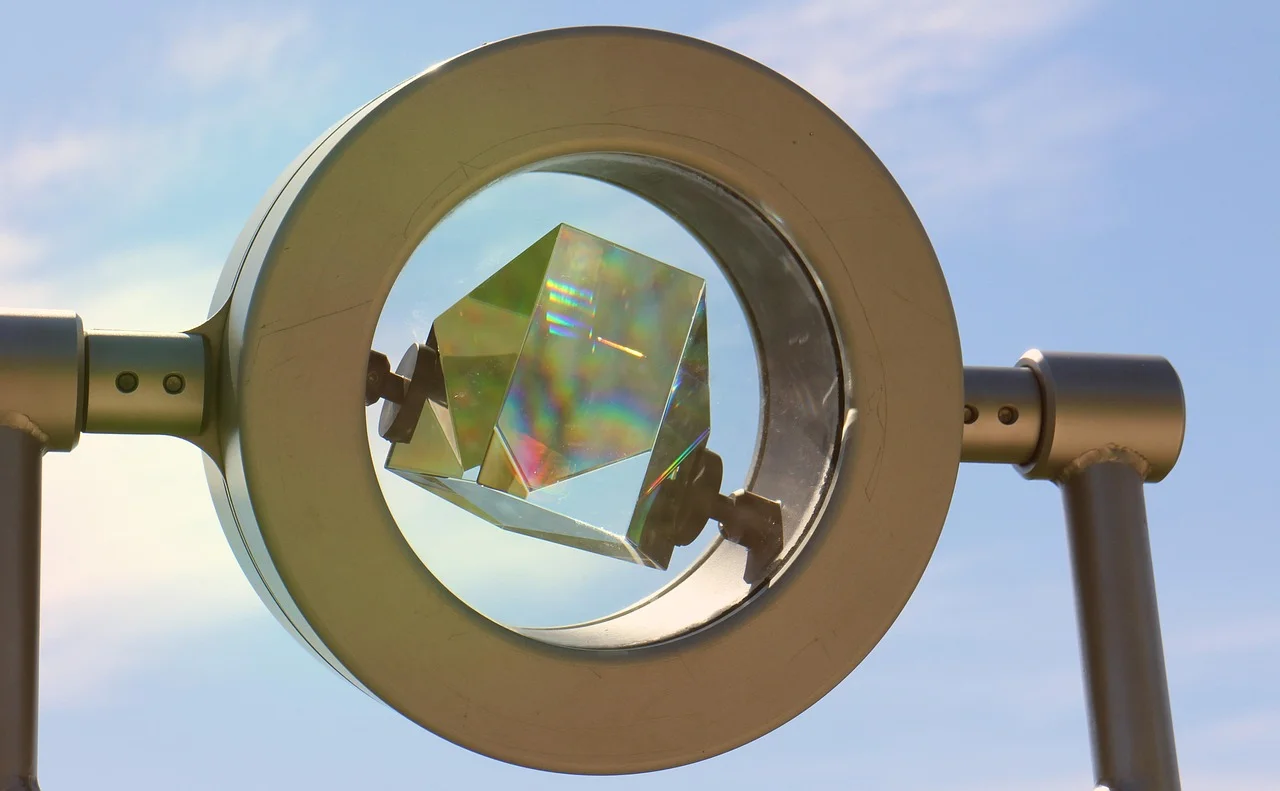
A prism makes this easy to picture. NASA explains that sunlight passing through a prism separates into rainbow order because different wavelengths bend by different amounts. The rainbow was already inside the sunlight; the prism just spreads the colors apart so we can see them.
So why does the Sun often look yellow, orange, or red from Earth? The air gets in the way. Blue and violet light scatter more easily in the atmosphere because their waves are shorter. That scattered blue light is why the sky looks blue, and it also means the direct sunlight reaching your eyes can look a little warmer.
Sunrise and sunset push the effect further. When the Sun is low, its light travels through more air before it reaches you. More blue light is scattered away, so more yellow, orange, and red light comes straight through. The Sun did not change color; the long path through the atmosphere changed the mix that reached your eyes.
There is also a second source of confusion: astronomers call the Sun a G-type yellow dwarf. That label is part of a star-classification system based on temperature and color categories. It does not mean the Sun is painted school-bus yellow when seen from space.
What about the claim that the Sun is green? That comes from looking at where a simplified solar spectrum has its strongest visible output. Las Cumbres Observatory explains that Sun-like stars can emit most strongly in the yellow-green part of the spectrum, but they also emit plenty of red and blue. Your eyes blend the whole mix, so the result looks white, not green.
Many dramatic Sun pictures add one more twist. Some solar images use artificial colors, and some show wavelengths, such as ultraviolet, that human eyes cannot see. A blue, gold, or green solar image may be a useful scientific picture, but it is not always what your eyes would see.
So the practical answer is simple: the Sun’s full visible light is white. Near the horizon, it can look yellow, orange, or red because its light passes through more atmosphere before it reaches you. And whatever color you call it, do not stare at the Sun directly; its light is still strong enough to damage your eyes.
References
- How to Determine the Color of the Sun? – Stanford Solar Center
- Why Is the Sky Blue? – NASA Space Place
- Visible Light – NASA Science
- The Appearance of the Sky – UCAR Center for Science Education
- Spectroscopy 101 – Light and Matter – NASA Science
- Stars in an Exoplanet World – NASA Science
- Black-body Radiation – Las Cumbres Observatory
Explore More
- Why does the sky look blue instead of violet?
- Why do sunsets turn red after volcanic eruptions or wildfires?
- Why do telescopes color some space images artificially?
- Why are there no green stars?
- How did Newton use prisms to study sunlight?