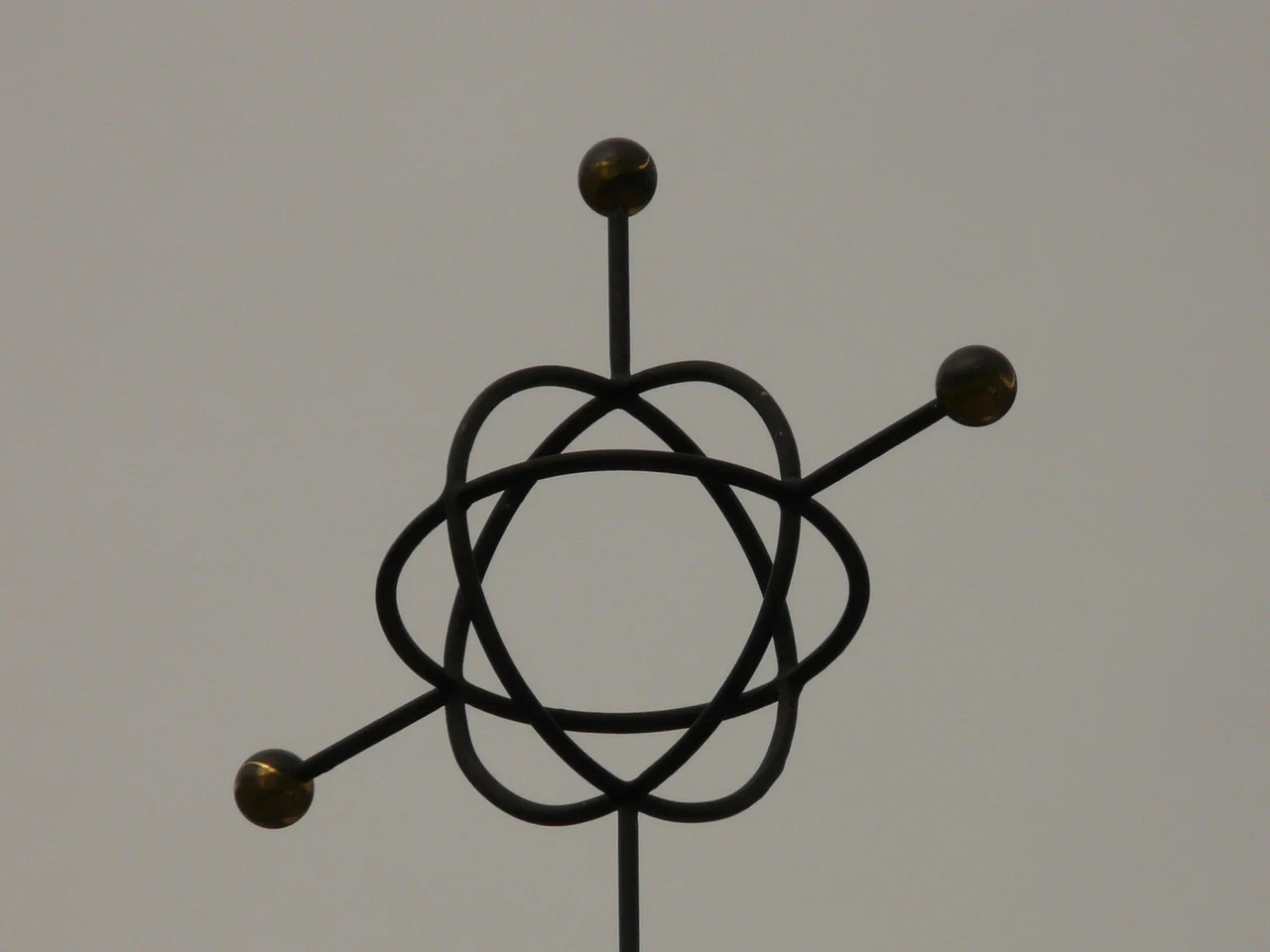
Atoms are often described as “mostly empty space” because the nucleus is tiny compared with the whole atom. Rutherford’s gold foil experiment showed that most alpha particles passed through the foil, which led to the idea that atoms have a small, dense nucleus surrounded by a much larger region.
But that larger region is not useless nothing. In a modern picture, electrons do not move like little planets in neat circular orbits. They form electron clouds: regions where electrons are likely to be found. Those clouds carry electric charge, and electric charge matters a lot when two pieces of matter get close.
When your hand presses on a table, the atoms in your skin and the atoms in the table do not politely slide through each other. Their outer electron clouds interact. The electromagnetic force makes opposite charges attract and like charges repel, and the Department of Energy explains that this force is what keeps atoms together in the first place.
There is also a deeper quantum rule called the Pauli exclusion principle. Britannica states that no two electrons in an atom can be in the same state or configuration at the same time. In plain language, electrons cannot all pile into the same lowest-energy “seat.” This rule helps explain why atoms have structure instead of collapsing into a tiny lump.
So the solid feeling of a table is not caused by tiny hard balls bumping into each other. It is caused by forces and quantum rules resisting overlap. Live Science gives the same basic picture for why you cannot walk through a wall: electrostatic repulsion and the Pauli exclusion principle stop atoms from occupying the same space in the ordinary way.
A table is also a solid because its atoms are held in a structure. OpenStax’s physics text explains that atoms in solids stay near fixed positions and resist stress and compression. They can vibrate, but they do not freely flow past their neighbors the way atoms or molecules can in a liquid.
Your sense of touch is really your nerves detecting those resisting forces. When you push on the table, the table pushes back through the electromagnetic interactions between atoms. Your hand does not need to meet a miniature brick wall inside each atom. It only needs those atomic-scale forces to push back strongly enough.
The short version is: atoms have lots of space inside them, but matter is not made of empty boxes. Electron clouds, electric forces, chemical bonding, and the Pauli exclusion principle make ordinary matter stable and resistant to being squeezed through other matter.
References
- Evolution of Atomic Theory | OpenStax Chemistry 2e
- Elements and Atoms: The Building Blocks of Matter | OpenStax Anatomy and Physiology 2e
- The Electromagnetic Force | Department of Energy
- Pauli Exclusion Principle | Britannica
- What Is a Fluid? | BCcampus OpenStax College Physics
- Why Can’t We Walk Through Walls If Atoms Are Mostly Empty Space? | Live Science
Explore More
- Do atoms ever really touch each other?
- Why can light pass through glass but not through wood?
- What is an electron cloud?
- Why do solids, liquids, and gases feel so different?
- Could quantum tunneling ever let a person pass through a wall?