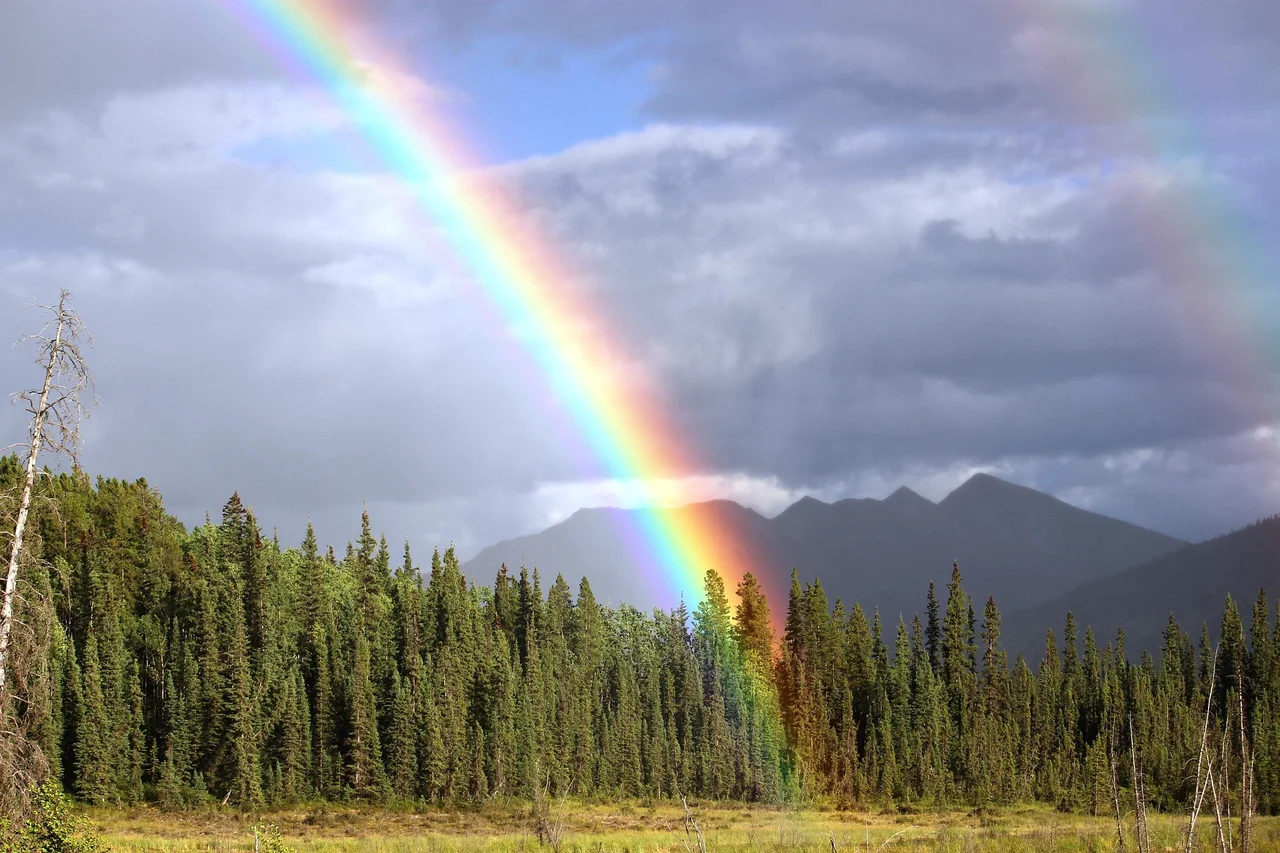
Yes, a rainbow really can be a full circle. But probably not for the reason the question suggests. The wording hints that a bigger rainbow might curl all the way around into a ring, which isn’t quite how it works. Here’s the strange bit: every rainbow you have ever seen is already a complete circle. You just almost never get to see the whole thing.
The shape comes from what light does inside a raindrop. Sunlight goes in, bounces around, and leaves at a fixed angle of about 42 degrees. That angle isn’t measured from just anywhere. It’s measured from a very specific spot in the sky called the antisolar point, which sits directly opposite the sun. Draw a line from the sun, through your head, and out the other side; that’s where it lands. Every raindrop that sends light back to your eyes at that 42-degree angle lights up. And because the angle is the same in every direction around the antisolar point, all those glowing drops trace out a circle.
So why do we usually see only an arc? Look at where the center of the circle sits. The antisolar point is opposite the sun, so whenever the sun is up in the sky, the antisolar point is below the horizon. The bottom half of the rainbow’s circle would be down there in the ground, and the earth just chops it off. What’s left poking above the horizon is the familiar arc.
This is where the idea of a “biggest” rainbow falls apart. The circle itself never changes size. Every point on it always sits about 42 degrees from the antisolar point, regardless of the storm or the sun. What changes is how much of that fixed circle you happen to be able to see. A rainbow never grows. You just sometimes get a better view of the same ring.
From flat ground there’s a hard ceiling on how much you can see. The most you can ever catch is a full half-circle, and that happens only when the sun is sitting right on the horizon at sunrise or sunset. At that moment the antisolar point is on the horizon too, so a complete semicircle stands above the ground. As the sun climbs higher, the center of the circle sinks lower, and the arc shrinks with it. Once the sun is more than about 42 degrees above the horizon, the whole bow drops out of sight. That’s why you rarely see a rainbow at midday.
To get past the half-circle limit and see a true ring, you have to change your own position rather than wait for a bigger rainbow. The trick is to get raindrops below you, so there’s no ground left to cut off the bottom half. That’s why full-circle rainbows tend to show up from airplanes or from the top of a tall mountain in a passing shower. With rain falling beneath you, the complete 360-degree ring can appear, often wrapped neatly around the shadow of the plane.
Picture the rainbow as a giant hoop painted in the sky, centered right on the shadow of your own head. Standing on the ground, your body and the solid earth block the lower part of the hoop, so you see an arch. Lift yourself above the falling rain, in a plane or on a peak, and there’s nothing left to hide the bottom. The whole hoop shows up at once.
So the answer to the original question is really a friendly correction. Full-circle rainbows are real, and pilots photograph them regularly. But they’re not a bigger rainbow. They’re the same 42-degree circle every rainbow already is, finally seen in full. Down here on flat ground, the grandest one you will ever catch is a half-circle at dawn or dusk.
References
- What Causes a Rainbow? – NOAA NESDIS
- Rainbow – National Geographic Education
- Low and High Rainbows – Atmospheric Optics
- The Antisolar Point – Atmospheric Optics
Explore More
- Why does a rainbow always appear on the opposite side of the sky from the sun?
- What makes the colors in a rainbow line up in the same order every time?
- How does a fainter second rainbow form above the main one, and why are its colors reversed?
- Why can two people standing side by side never see the exact same rainbow?
- What are “glories” and “fog bows,” and how are they related to rainbows?