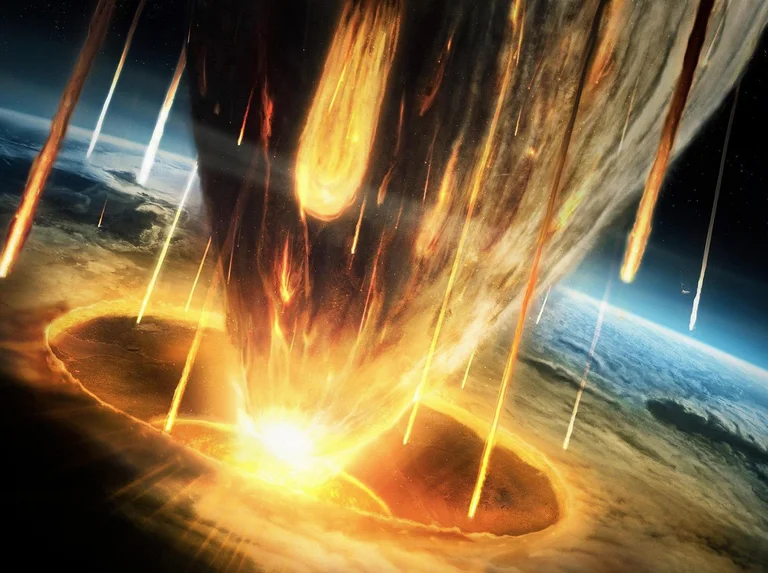
The K-Pg boundary, also known as the K-T boundary, is a thin layer of sediment found in rock formations all around the world. It represents a significant moment in Earth’s history: the boundary between the Cretaceous Period and the Paleogene Period. This boundary marks the end of the reign of the dinosaurs and the beginning of a new era for life on Earth.
The K-Pg boundary is especially noteworthy because it contains an unusually high concentration of the element iridium. Iridium is a rare element on Earth but is found in abundance in asteroids and comets. This discovery, made in the 1980s by a team of scientists led by Luis and Walter Alvarez, provided strong evidence for the theory that a massive asteroid impact caused the extinction of the dinosaurs.
The K-Pg boundary is like a time capsule, capturing the moment of the impact and its immediate aftermath. It contains other clues about the event, including shocked quartz, tektites (glassy objects formed from melted rock), and a layer of soot that likely came from wildfires ignited by the impact.
Scientists study the K-Pg boundary to understand the events that led to the extinction of the dinosaurs and how life on Earth recovered from this catastrophic event. It is a powerful reminder of the fragility of life and the potential for sudden, dramatic changes in the Earth’s environment.
References
- Cretaceous–Paleogene boundary
- K-Pg boundary: Evidence for the Asteroid Impact
- The K-Pg Boundary: The Day the Dinosaurs Died
- K-Pg Boundary: What Killed the Dinosaurs?
- The K-Pg boundary: The End of the Dinosaurs
Explore More
- What other evidence besides iridium is found at the K-Pg boundary?
- How did the asteroid impact affect the Earth’s climate and environment?
- What types of animals and plants survived the extinction event?
- How did life on Earth recover after the impact?
- What are the implications of the K-Pg boundary for understanding the history of life on Earth?