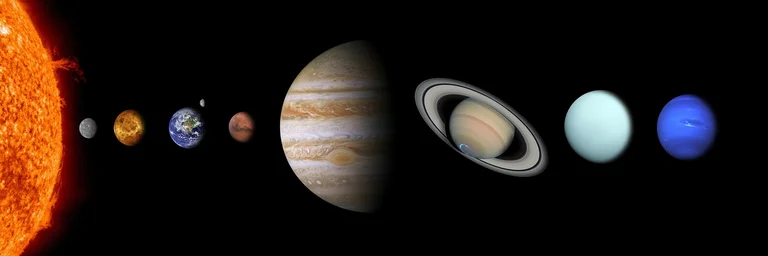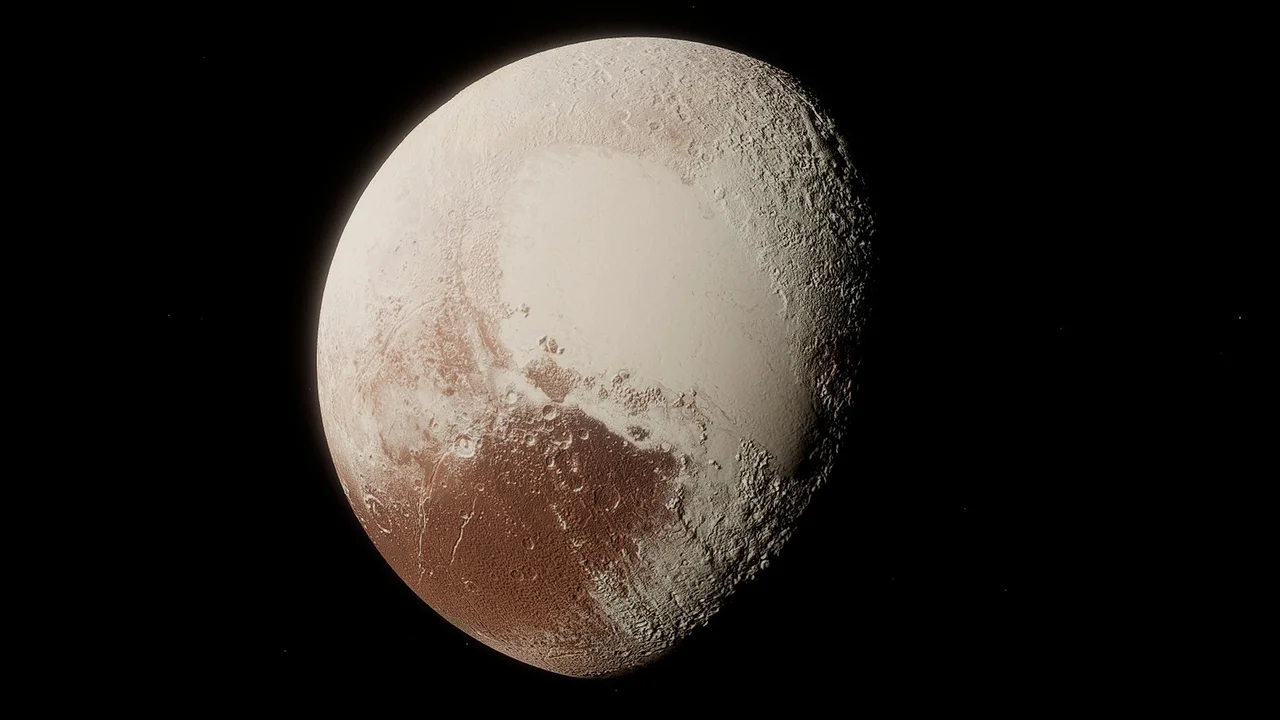
The funny thing is that nothing about Pluto actually changed. It is the same icy little world it always was. What changed in 2006 is that astronomers finally wrote down an official definition of the word “planet,” and Pluto did not quite fit it. So it was not destroyed or lost; it was reclassified as a “dwarf planet.” The decision was made by the International Astronomical Union (IAU), the global body that sets naming and classification rules in astronomy.
Under the IAU’s 2006 definition, to count as a full planet an object has to pass three tests:
- It orbits the Sun.
- It is massive enough that its own gravity pulls it into a nearly round shape.
- It has “cleared the neighborhood” around its orbit.
Pluto passes the first two easily. It orbits the Sun, and it is round. It is the third rule that trips it up.
So what does “clearing the neighborhood” mean? The idea is that a real planet is the gravitational boss of its orbital lane: over billions of years it has swept up, flung away, or captured the other debris that shares its path. Earth is a good example of dominance: it is roughly 1.7 million times the mass of everything else in its orbital zone. Pluto is the opposite. Its mass is only about 0.07 times the combined mass of the other objects sharing its region, so instead of ruling its lane, it is just one resident among many.
That “many” is the key to the whole story. Pluto lives in the Kuiper Belt, a vast ring of icy bodies out beyond Neptune. For decades Pluto looked like a lonely ninth planet, but as telescopes and digital cameras improved, astronomers started finding lots of similar worlds out there, with names like Quaoar, Sedna, and Makemake. Then in 2005 came the clincher: Eris, an object about as massive as Pluto, arguably even more so.
That discovery forced an awkward choice. If Pluto counted as a planet, then Eris had to be one too, and probably a whole growing list of Kuiper Belt objects behind it. Astronomers would either have to keep adding new planets indefinitely or draw a clear line. In 2006 they drew the line with the new definition, and Pluto landed on the dwarf-planet side of it: a body that meets the first two tests but not the third.
It is worth saying that this was a bookkeeping decision, not a discovery that Pluto had somehow shrunk or vanished. Plenty of scientists still grumble about it, and the debate flares up again every few years. But the reclassification was really about consistency: once you have a clear rule, you have to apply it to Pluto the same way you apply it to Eris.
In the end, Pluto did not get demoted so much as reassigned. Rather than being the smallest, weirdest misfit among the planets, it became something arguably more interesting: one of the largest members of a whole newly discovered population of icy worlds at the edge of our solar system.
References
- Pluto: Facts – NASA Science
- Why Is Pluto No Longer a Planet? – Britannica
- Why Pluto is no longer a planet – BBC Sky at Night Magazine
- Pluto – Wikipedia
Explore More
- What exactly is a dwarf planet, and how many are there in our solar system?
- What is the Kuiper Belt, and what else lives out there?
- How big is Eris compared to Pluto, and why did its discovery matter so much?
- What did NASA’s New Horizons mission reveal when it flew past Pluto in 2015?
- Could Pluto ever be reclassified as a planet again?